
I used to be a sticky note person. This meant sticky notes splattered all over my wall and work desk. This may have been a reflection of how disorganized I felt and still feel sometimes.
But, as I’ve learned over the years, especially now that I’m going back to college, it’s important to be organized. Well, how can we do this?
One way is with effective to-do lists.
In this post, you’ll learn what counts as an effective to-do list as well as why they’re important. You’ll, most importantly, gain a set of tools for your arsenal on how to create one to finally get stuff done with less stress.
These tips have been a gamechanger for me.
What is an Effective To-Do List
An effective to do list has a list of mini goals you have for a period of time that are written down.
They guide you through planning your day so that you can be productive and realistically achieve the things you want and need.
Why Effective To-Do Lists are So Important
Clarity.
Clarity is when you know exactly what you want to do, why you want to do it, and when you’re going to do it. As a working student, clarity is imperative for your to-do lists.
This is because without it, you may be focusing on ‘fluff’ tasks that don’t move the needle much; rather, they just help you feel productive.
On the other hand, the lack of clarity with what you need to do for big class assignments, work projects, or even life responsibilities can lead to stress and overthinking. In this season, we especially need less of that.
Energy management.
Reduced overthinking and stress means greater energy management.
Here’s what I mean: The biggest problem I’ve noticed as a working professional going back to college is that the more my brain is ruminating on what could go wrong, the more exhausted and overwhelmed I feel.
Energy is one of the most important resources to have in order to be successful in work and college. The downside is that energy is limited.
Reducing how much energy you spend on negative things, and replacing it with events that replenish your energy (whether that be hobbies or sleeping) is the best way to ration it.
Creating effective to-do lists helps us accomplish just that.
Reach your goals more effectively.
As mentioned earlier, having clarity on what pushes you further to success, allows you to minimize how much unnecessary pressure you put on yourself with useless tasks. Our goal is efficiency, not who can look the busiest.
The thing you feel the most pressure to complete, is probably the thing you need to put on your task list. Even if it sucks. That is how we can reach our goals faster with less effort.
Build confidence in yourself.
When you set a goal for yourself, you plant a seed in your brain. Each time you complete a small task on your list that moves you closer towards that goal, you water that seed.
In other words, the more tasks you do, the easier it will be to create and complete them.
Eventually that seed will turn into the tree. Think of the seed to the tree progression as the amount of trust with yourself: It builds each time you do what you said you were going to do.
Now that we have some of the benefits of effective to-do lists, here are some ways that I write effective to-do lists that allow me to complete class assignments and keep my job.
How You Can Write To-Do Lists You Can Actually Accomplish
Write it down.
If you’re like me, you probably have a bunch of items already swirling around in your head. Writing these tasks down, whether it be outlining a paper or drafting a presentation, is like taking these tasks from your brain and pulling them down onto paper.
This helps to immediately relieve some of the stress and overwhelm because you don’t have to worry about forgetting it.
So, you can start off by writing down the things that are in your mind.
Then, narrow them down to the biggest things that will help you get closer to passing the class or reaching your job quota.
Break big projects into smaller tasks.
This allows you to build clarity. Writing down “Write government paper” is a big project. If that is what I see on my to-do list, I’m already freaking out about what to do first.

Instead, I like to break something like this down into stages that I will spread out across the week.
- Copy and Paste instructions into the program where I’ll be drafting my paper.
- Outline the paper based on the questions I need to answer from the instructions
- Create topic sentences for each paragraph that give a gist of what I’ll be explaining
- Find Research that supports the paragraph (and cite sources as I go)
And so on and so forth. If you want the entire system to write an academic research paper as a working student, check out this post.
Plan your to-do list for the entire week.
Planning everything at the beginning of the week allows you to realistically break down the progress you need to make in order to complete your big projects.
I have tried planning day-by-day, but it feels like living paycheck-to-paycheck: I don’t have enough wiggle room to adjust if needed. Plus, I can be a poor estimator of how long something may take.
Planning at the beginning of the week helps me avoid procrastination and avoid stressing about if I will actually finish what I need to do.
Assign time periods that you plan to accomplish each task.
You don’t have to assign specific times, just time blocks. For me, I like to assign blogging to the beginning of my day.
I wake up before 6am so that I can make time for more tasks. It is so worth it. If you’re not a morning person, or need to find more time in your day, check out this post for some tips. Anyways, most of the time I do my classwork tasks after my blogging tasks.
If I don’t complete everything on my list, I have an additional time block for my work lunch break as well as my evening after I get home from work.
As a note, I know that I am exhausted after work, so doing everything in the morning is when I am most productive.
Make sure you show up for those time blocks.
If you can’t, pick a time in the future where you’ll address the task.
I use my own spin of the bullet journal system to plan my weeks and days. If I can’t get to a task, I choose a later time-block or make a schedule to work on it the next day.
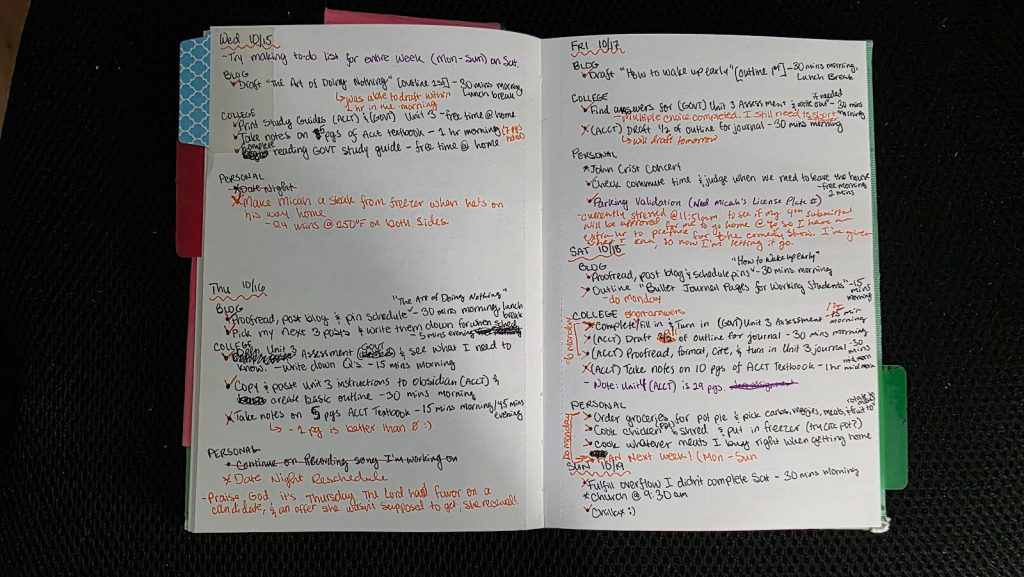
Some tasks I just x off and decide that they just won’t get done. I don’t do this often because I try to make my list as streamlined as possible with no unnecessary work; however, sometimes I can get away with not reading my 10 pages for accounting class.
It goes back to making sure your tasks are small enough that you believe that you can complete them.
If you shy away or feel like procrastinating on tasks, you may need to break down that task into something simpler.
That’s how my brain works, at least.
Don’t overcommit
Being high-achievers can mean that we overestimate how much we can actually do in a few hours.
Be honest with yourself.
I’ve found that it’s easier to underestimate how much I can do in 30 minutes and have buffer time, rather than overestimate and stress about not being able to complete everything in that time-block.
Make your to-do list pleasant to look at.
Get a cool notebook and use some colored pens! I love the G2 gel pens.
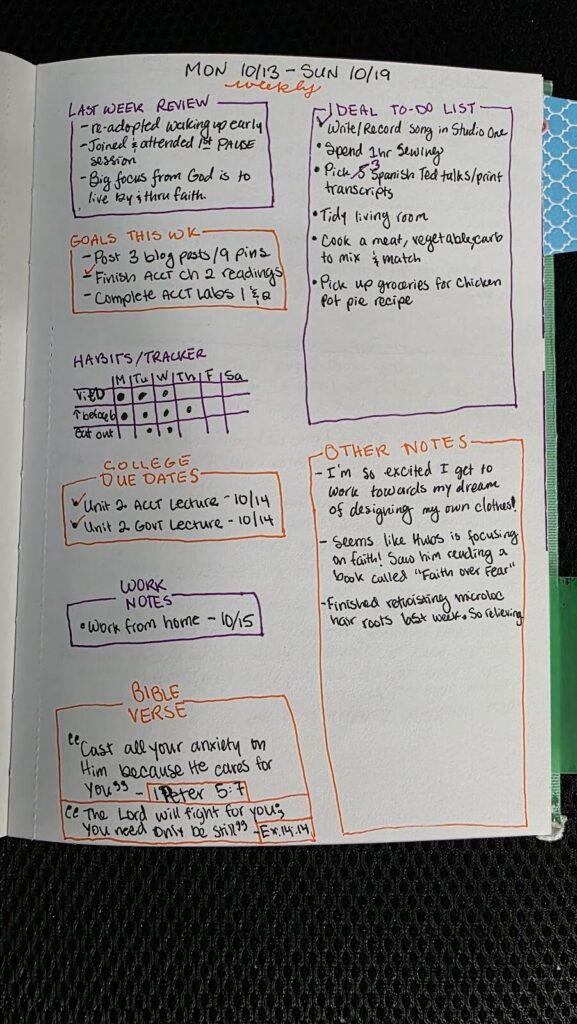
I just use a simple sketchbook to write in. To see an example set up that has helped me to catch up with my classes, check out this post.
Always address your to-do list.
Don’t avoid it. Even if that means you have to move things around. For me, I sometimes feel ashamed when I don’t feel up to doing something. But, burying my head in the sand never helps in the long-run.
Instead, when I’ve been feeling that way, I’ve opened my notebook anyway and either moved tasks around or crossed them off. Doing this forces me to face the music, and oftentimes, I convince myself to at least do something to stay on track.
Somehow, facing it helps remove the shame involved too.
Even if it’s not everything. Getting out of having an all-or-nothing mindset has allowed me to be happy with making some progress, even if it wasn’t everything I had hoped.
As a side note, the all-or-nothing mindset is when we feel like we have to be able to accomplish something 100% in order to be successful. If we feel like we can’t do something all the way through, we often scrap it and do nothing at all.
In other words, we count the task, or even the whole day, as lost.
Anyways, I have become addicted to not feeling stressed as a working student. Sticking to my daily to-do list is a huge part of that. I remember what it feels like to procrastinate to start and finish a paper on the Saturday before it’s due. It’s not fun at all.
Keep everything neutral.
I do what I can to avoid inducing negative emotions around my to-do list. For example, when I don’t complete a task, I make it a point to not tell myself “I wasn’t productive.”
Rather, I keep it neutral, like “I did not work on this today. Is this something that I need to address later?”
If I do need to address it later, I assign it to a different day or time period.
I truly believe that doing this has allowed me to relieve the stigma I had about to-do lists. I used to think that they were strict, rigid, and left me with no freedom; however I have found that having effective to-do lists has allowed me to find freedom.
More energy freedom because I’m not concerned about when or if things will get done. More time freedom because I don’t have to spend my entire Saturday catching up with what I didn’t do on Thursday.
Mindset is huge with this, and the more benefits you realize when you implement these methods, the more you’ll feel the same way.
Reflections
This doesn’t have to be a big thing where you write out a full page of what you did last week. Rather, keep small notes of things that worked, and things that didn’t.

I like to do this with different colors on each task. If things take longer or shorter than expected, I write it next to the task in different ink.
If a task replenishes my energy, I note it as well. Not only does it make the page look cooler and more filled, I can look back on it too!
Conclusion
This post covered what an effective to-do list is, the benefits, and how you can create an effective to-do list for yourself.
I have shared all of my to-do list secrets in this post that have skyrocketed how much time and energy I have in my day.
This list has been years in the making for me, so if you’re just starting out, pick one tip from above and implement it for a week. Then, stack another one on top of it.
This will help you to get the ball rolling on getting things done, without feeling overwhelmed about following every single one of these all the time.
Spoiler: I don’t even do all of these steps every time. However, when I do, I see the benefits right away.
If you feel behind as a working student, check out this post next to see how you can catch up fast with less stress, and take back control of your life.
Also, join the email list down below for more helpful information for working students to balance your job, college, and life.