If you’ve ever woken up one day and felt like a chicken running around with no head, you are definitely not alone. As working students, it can be difficult to balance our jobs and our classes while keeping up with life.
Over the past week, I have found a solution to this scatteredness. And the answer is doubling down with planning with my bullet journal.
A Non-Overwhelming Intro to Bullet Journaling for Working Students
There are many resources online explaining what bullet journaling is. But for the purpose of this post, I’ll explain it simply like this:
Bullet journaling is a method by Ryder Caroll where you write down your to-do lists, journal, track habits and keep collections of lists (like your favorite books, movies, etc) all in one place.
In other words, it’s basically an everything notebook.
If you’re just getting started in the planning/bullet journal space as a student, it can be overwhelming with how many artistic pages there are with beautiful drawings. You’ll also find different collections and trackers for finances, favorite books, and anything else you might think of.
Don’t worry about those right now. In this post, you’ll see the templates I’ve been using that are simple/easy to create that will cover your needs for work, school and life.
These layouts have helped me to catch up when I was behind in school and stay consistent. All you’ll need is a cheap notebook, and colored pens to help make it pretty (if you so choose).
The Only 3 Bullet Journal Spreads You’ll Ever Need as a Working Student (At least to get started)
Working Student Page #1 – The Monthly Overview
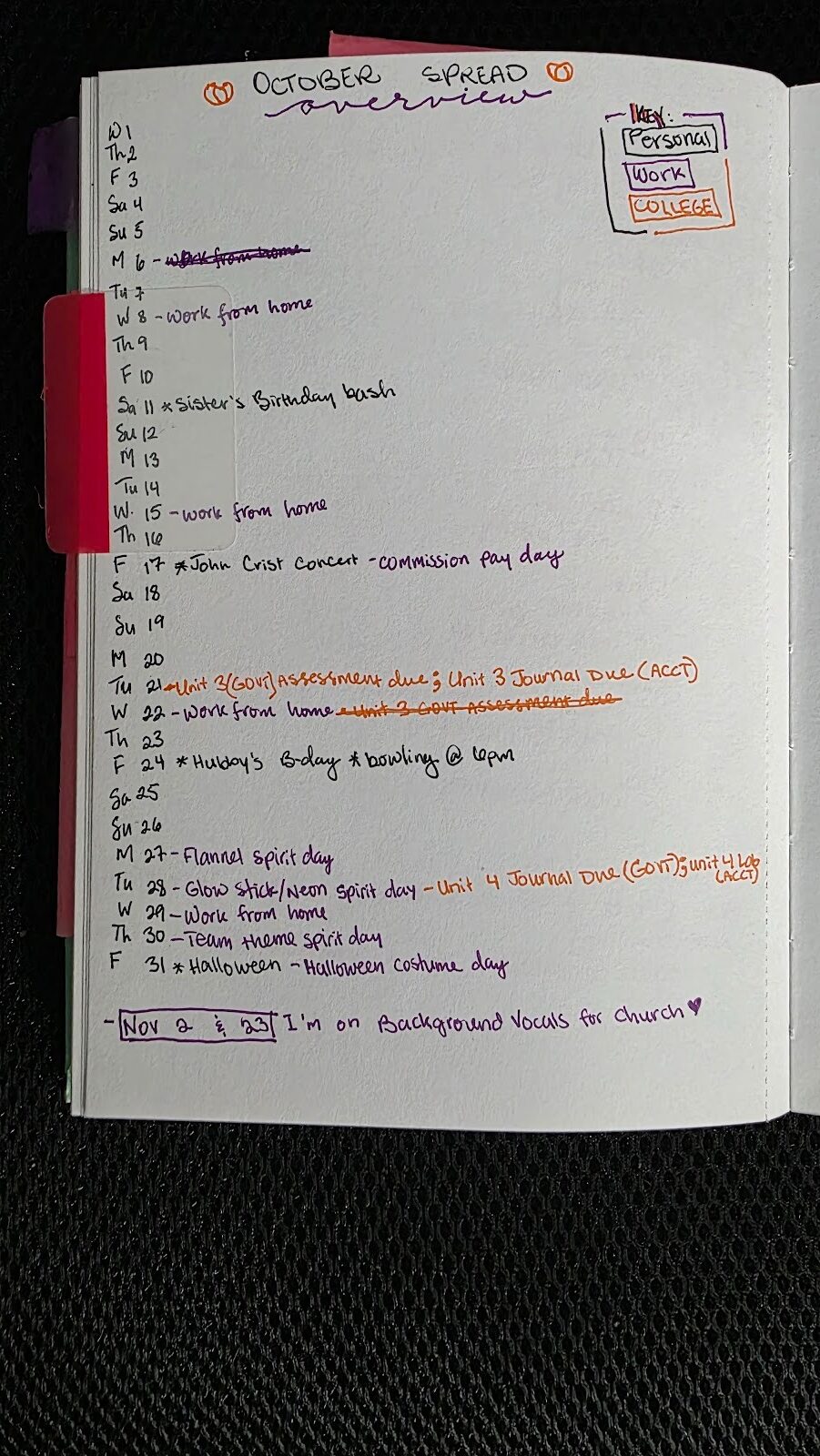
The purpose of this spread is to help you see an overall picture of the month ahead. It will help you to plan out your days around upcoming deadlines and events, so you’re not blindsided when something at work or school becomes due.
Here’s my setup:
- I write out the day of the week and day of the month next to each other down the left side of the page.
- I put stars (*) next to events happening on a day.
- I color coded my job related details in purple, school deadlines in orange, and personal/general details in black. The Color Key is in the top right.
- At the top I just added my attempts at Pumpkins in orange ink for October.
- At the bottom, I put a couple important dates I need to keep in mind for November.
I like this set up because it’s simple, sleek, and easy to skim. Don’t overthink it. If you mess something up, just scratch it out and write next to it.
Working Student Page #2 – The Weekly Overview
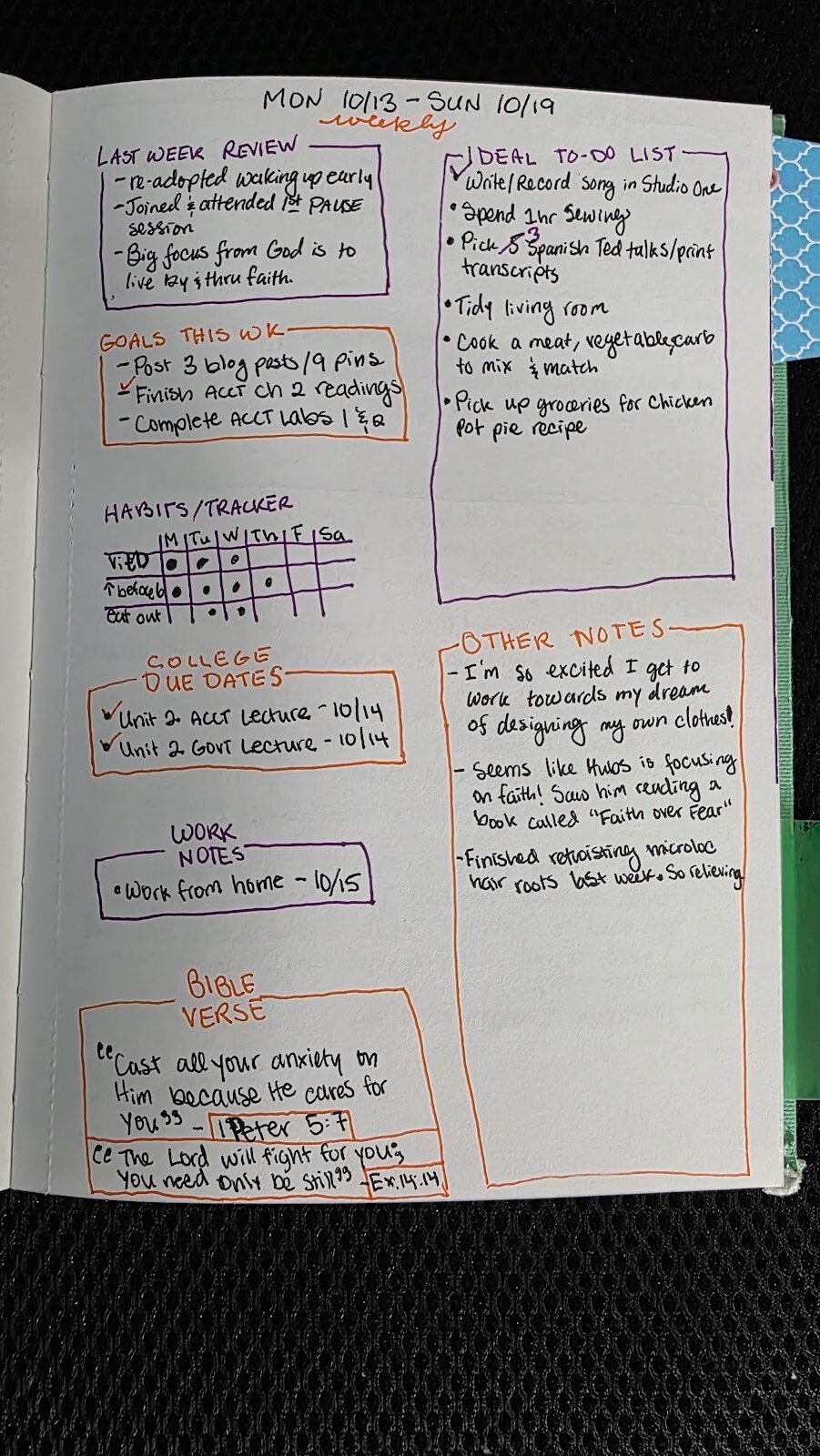
Here’s another variation for another week in October
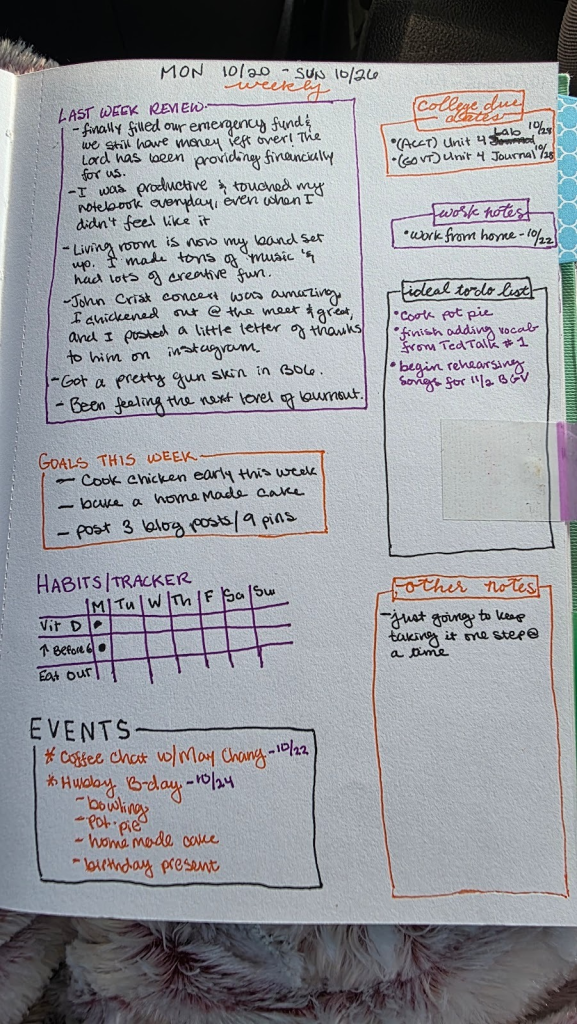
The purpose of this page is to get a general overview for the week ahead. Think of it like a dashboard of sorts. Notice that my lines are far from straight. I don’t use rulers for these.
Also, in order to make it look prettier, I’ve been outlining the boxes in different colors, and switching between print, all caps, and cursive when it feels right.
For these weekly pages, I’ve been including the following sections:
Last week’s review.
This part just has a few bullet points listing the highlights of my previous week. Doing this helps me to not focus on the future, as well as appreciate and recognize what has happened in the past.
Goals this week.
This area has 3 things that I hope to accomplish this week. As you can see in the first image, the 1st 2 goals have a checkmark next to them, while the 3rd goal has an X.
This just means that I completed the 1st 2 goals, but did not complete the 3rd.
This is my own spin on the bullet journal system. It helps me to tell the difference between the things I did, and the things I didn’t do. The important thing is to recognize, not penalize.
Habits/Tracker.
This part allows me to see if I did something or didn’t do something for that day. I don’t mark it as positive or negative. I also have partially completed days marked as half circles. Limit to 3 habits to start.
College Due Dates.
This section has any upcoming deadlines this week or early next week I need to work toward.
Work Notes.
Anything important related to my job goes here.
Bible Verse.
I’ve been struggling with overthinking about the future, so this part helps me to remain focused on God.
Events.
This section has upcoming events that are happening this week.
Ideal to-to list.
This part has tasks that I would like to accomplish this week if everything went perfect.
Notice that on the 3rd bullet point on my first image, I crossed out 5 and put 3 in purple and still checked it off. This helps get rid of the all-or-nothing mindset.
Remember that any progress is good progress.
Notice that I am also still using the check and x methods. Again, this is for recognizing what I did and did not complete. I do not penalize myself. We are already doing a lot. It would be unfair to put additional pressure on ourselves as working students.
Other Notes.
Anything that I want to note about the week as it goes on (or anything I remember from last week) goes here.
Working Student Page #3 – The Day by Day Breakdown
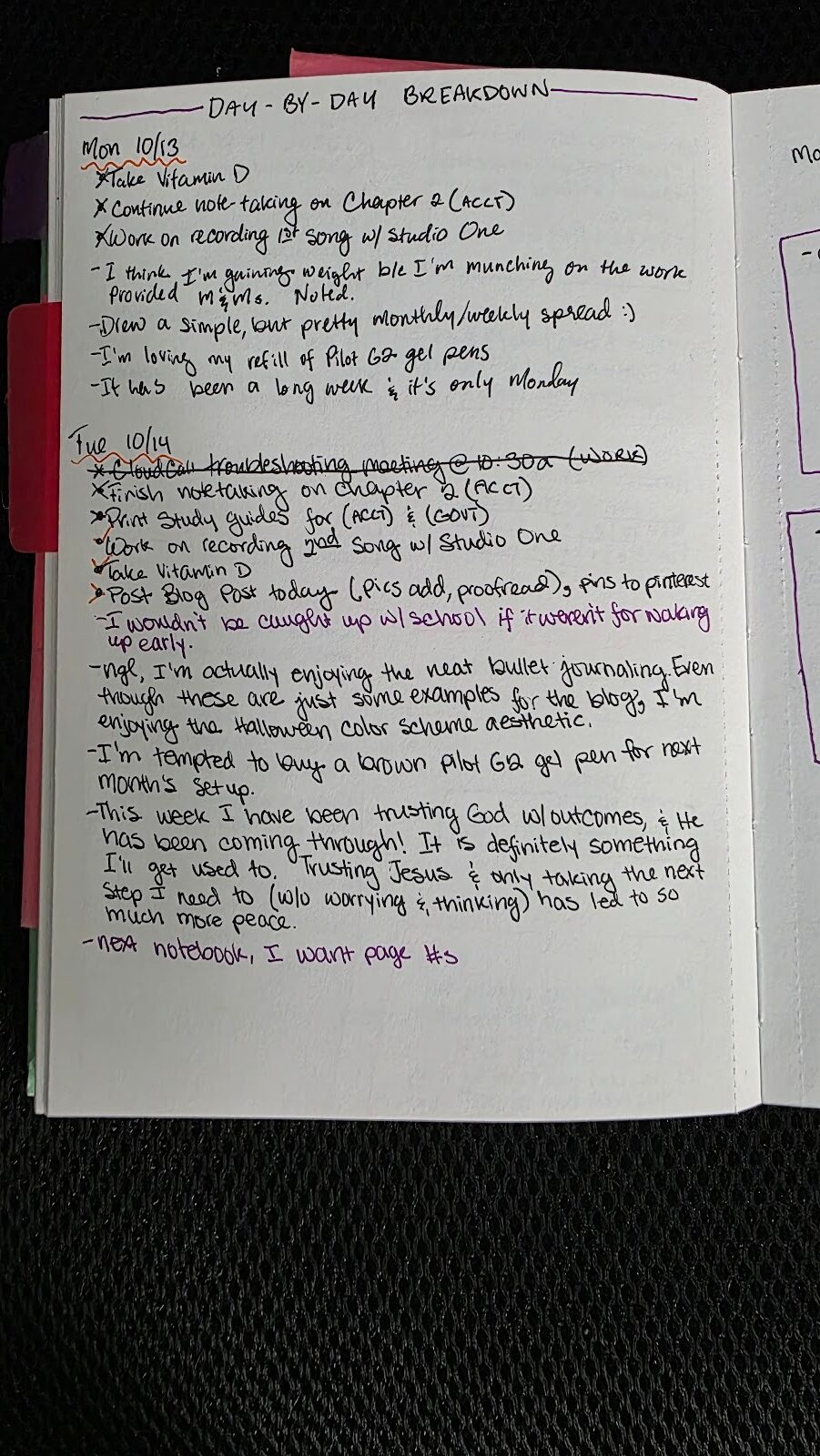
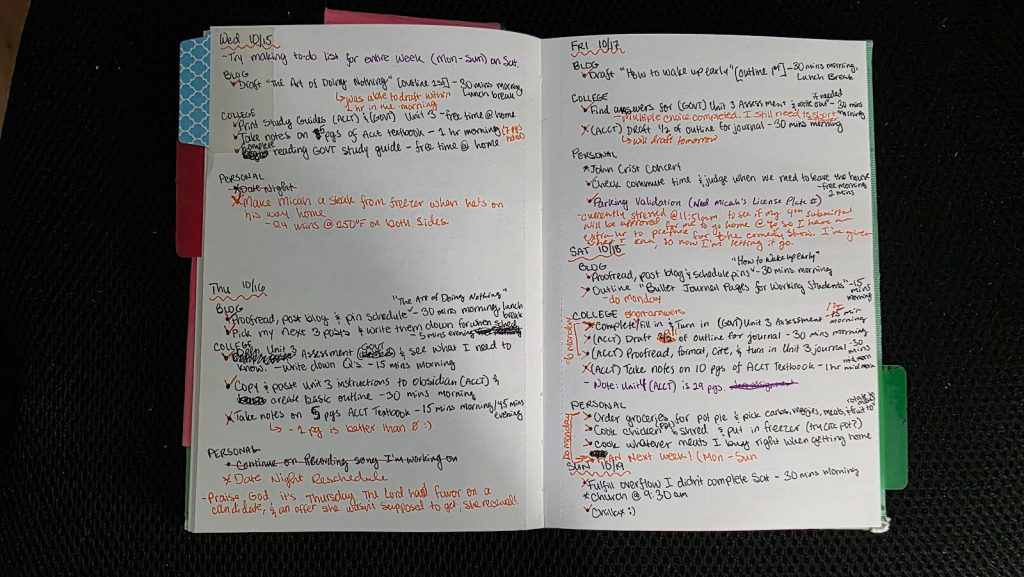
The purpose of these pages is to have a daily to-do list that I can follow. I plan everyday at the beginning of the week, for the entire week in advance.
This is so that I can easily sit down and get started on my tasks.
Here’s my process for this bullet journal daily spread.
How I set up easy daily bullet journal pages as a working student.
I split each page in half so that 2 days fit on each page. Then I include 1-3 tasks for each section of my life: Blogging, College, and Personal. If you use your bullet journal for work, you can put a Work section in there too. I just don’t have a need for it.
Notice how simple this is.
I’ll go into more detail in my next post on how I write to do lists that actually get stuff done, but here are the highlights. On Mondays I’ve been breaking up school and personal assignments to things I need to complete each day to accomplish them.
This includes reading/taking notes, drafting papers, and printing study guides.
To the right of the task, I put how much time I realistically estimate it will take to complete, as well as when in the day I will complete it.
For college tasks, that’s in the mornings when I wake up. Here’s a post on how to wake up early if you find you don’t have enough time in your day.
Extra important notes I indicate with a dash in purple ink.
Doing this helps me have peace because I have clarity on what exactly I need to do, and when I need to do it in order to successfully accomplish my tasks.
Each day, I also take notes next to the task in a different color.
If it took me longer to do something or I didn’t get to everything, I make a note, and set a time that day or the next to complete it. This helps me not worry about when things will get done.
Plus, because I do most of my work in the mornings, I have plenty of time in the evenings for fun.
I have extra space under my to-do list each day for day specific journal entries. I use a dash to notate this and a different color ink.
It’s nothing very elaborate, I usually just brain dump thoughts that come in during my day.
If you find you have more to write than the space you have, continue on a future page, and just make a note on where the continuation is on your initial journaling spot. This helps to not confine you to specific pages. This means more flexibility!
Conclusion
These 3 bullet journal pages will help you get through the semester and catch up if you’re behind. Just make sure to be honest with yourself in your journal, and to open it each day. This will help you build the habit.
The more you do this, the more you will tailor your student bullet journal to your own needs. Whether that means different formats, new pages, or whatever. Remember that the planner just needs to work for your life.
I hope these tips helped you! If they did, please join the email list down below for more helpful tips for working students.
2 thoughts on “The Only 3 Bullet Journal Spreads You’ll Ever Need as a Working Student (At least to get started)”
Comments are closed.